The built environment should serve human flourishing
Buildings, streets, and neighborhoods should be judged by shelter, dignity, family life, belonging, commerce, beauty, and durability—not by efficiency, novelty, or unit counts alone.

Subject collection · The built commonwealth
Build beautiful, durable, locally rooted places that strengthen families, ownership, civic memory, and intergenerational continuity.
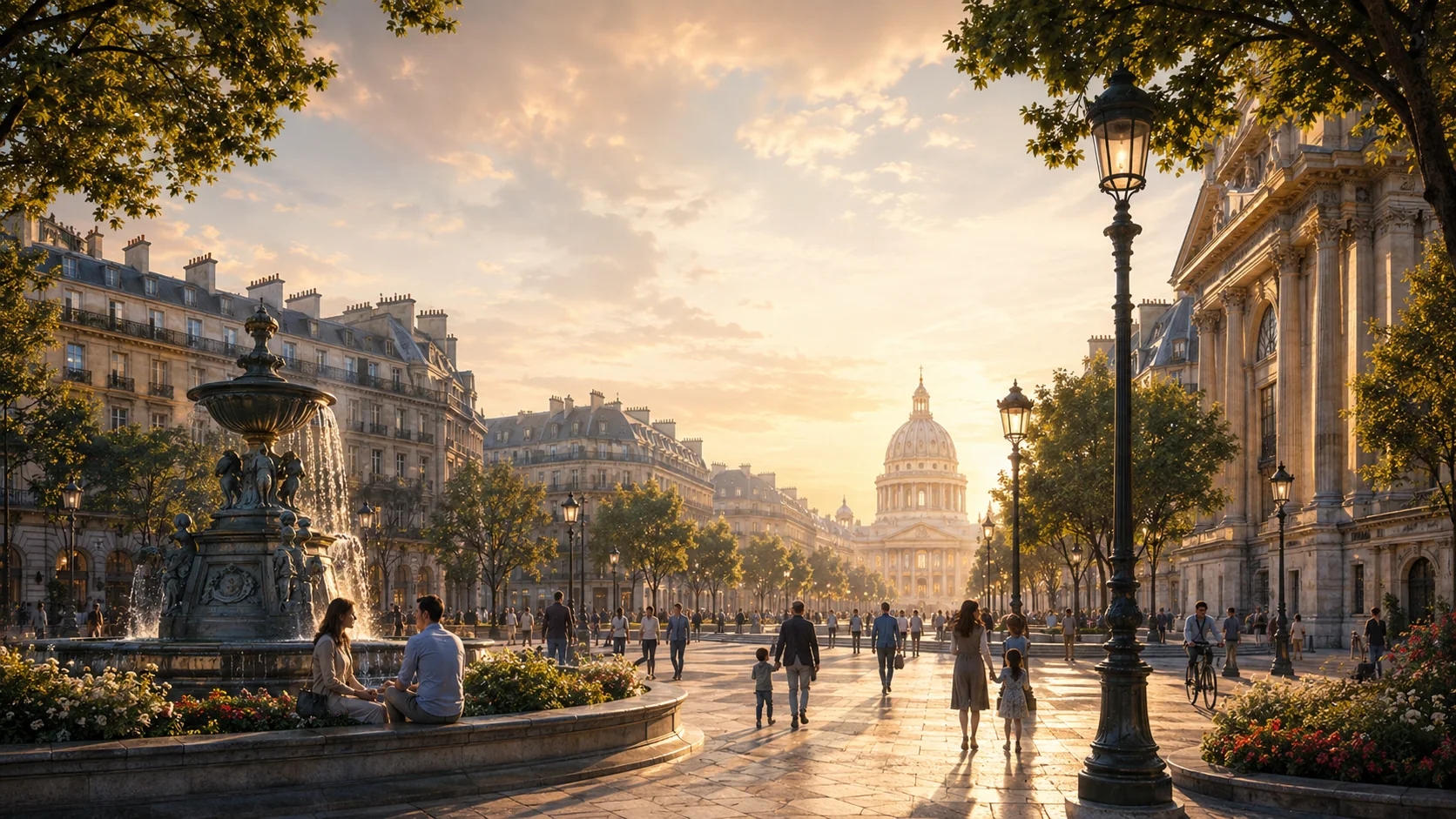
The built environment is more than private property or economic infrastructure. It is an inherited civic good, held in trust for neighbors and descendants.
The doctrine in one sentence
Build as though your grandchildren will inherit it—because they will.
This is neither a command to freeze places in a museum nor permission for each generation to consume the physical inheritance it received. Stewardship means receiving, repairing, adapting, building, and handing onward.
Thirteen principles
Architecture is never only a container. Its scale, materials, uses, ownership, placement, and relation to the street make some forms of life easier and others harder.
Buildings, streets, and neighborhoods should be judged by shelter, dignity, family life, belonging, commerce, beauty, and durability—not by efficiency, novelty, or unit counts alone.
Proportion, hierarchy, craftsmanship, coherence, material honesty, and appropriate ornament are intelligible public goods, especially in civic buildings and important places.
Inherited forms store practical and cultural knowledge. A living tradition adapts that language to present needs without reducing architecture to imitation or compulsory novelty.
Human scale, coherent streets, mixed uses, local identity, and incremental growth should take forms suited to regional climate, materials, settlement patterns, and culture.
Rowhouses, duplexes, courtyard apartments, small apartment buildings, and homes above shops can support families, churches, ownership, and stable neighborhoods.
Compact urbanism should widen the number of proprietors—homeowners, shopkeepers, cooperatives, small landlords, and family-owned multifamily buildings—not consolidate whole districts under absentee ownership.
Favor infill, adaptive reuse, small parcels, gentle density, and buildings that can evolve over clearance, megaproject planning, and permanent single-use rigidity.
Historic fabric holds craftsmanship, embodied resources, memory, and identity. The presumption is reuse before demolition: preserve significance and permit adaptation.
Squares, greens, parks, markets, libraries, churches, monuments, and civic halls give visible form to membership in a common life.
A street must balance movement, commerce, walking, parking, trees, deliveries, architecture, and encounter. Cars should be accommodated without becoming sovereign.
Repair, reuse, vacant-lot infill, and extensions of existing grids should ordinarily precede costly outward expansion and its long maintenance liabilities.
The city should remain legible: center and edge, sacred and ordinary, civic and private, permanent and temporary need not all demand equal visual attention.
Farmland, forests, rivers, watersheds, ecological systems, scenic corridors, and historic viewsheds belong within the same ethic of responsible use and transmission.
The preferred stewardship city
Neither a frozen nineteenth-century town nor a futuristic master-planned metropolis: a place whose ordinary parts can change without losing the civic whole.
Intellectual genealogy
No figure supplies the whole doctrine. The synthesis draws distinct strengths from theological, classical, civic, conservative, preservationist, urbanist, and fiscal traditions.
Foundations
Genesis · Aristotle · Vitruvius · Augustine · Aquinas
Land is cultivated and kept; the city serves the good life; building joins durability, use, beauty, and propriety; order and the common good are real.
Inherited practice
Greek and Roman civic form · Medieval towns · Alberti
Church, market, home, workshop, street, and square coexist. Renaissance humanism recovers proportion, hierarchy, human scale, and civic dignity.
Inheritance
Burke · Pugin · Ruskin · Morris & Webb · Leo XIII
Buildings transmit memory; craftsmanship carries moral meaning; conservation resists falsification; ownership supports household independence.
Civic composition
Camillo Sitte · City Beautiful · Ebenezer Howard
Streets and squares form spatial compositions. Public beauty can be deliberate, while town and country should be reconciled without dissolving urban life.
Recovery
Jane Jacobs · Aldo Rossi · Christopher Alexander
Mixed use, fine grain, collective memory, recurring patterns, and piecemeal adaptation recover the city from both chaos and total planning.
Contemporary synthesis
New Urbanism · Strong Towns
Walkable neighborhoods, defined civic space, regional response, productive land, small bets, and honest infrastructure accounting become one practical discipline.
The distinctive synthesis
Stewardship architecture is broader than traditional style, New Urbanism, preservation, or fiscal reform alone.
Draws from
Refuses
The architectural canon
These references are foundations and points of comparison—not claims that every author would endorse the whole framework.
Ancient
Hebrew Scriptures
Cultivation and guardianship: human authority over land begins as a received responsibility rather than absolute sovereignty.
Read the source4th c. BC
Aristotle
The city exists not merely for security or exchange but for the good life and the conditions of human flourishing.
Read the source1st c. BC
Vitruvius
Durability, convenience, beauty, propriety, and the civic responsibilities of architecture and city building.
Read the source4th–5th c.
Augustine
Beauty as more than arbitrary preference, bound to order, number, proportion, harmony, and the intelligibility of form.
Read the source13th c.
Thomas Aquinas
Natural law, ordered human ends, integrity, proportion, clarity, and law directed toward the common good.
Read the sourcec. 1450
Leon Battista Alberti
A legible architectural grammar of harmony, proportion, hierarchy, composition, and civic dignity.
Read the source1790
Edmund Burke
Society as an intergenerational partnership and the city as an inheritance to receive, modify prudently, and transmit.
Read the source1841
A. W. N. Pugin
Buildings embody social assumptions; construction, use, propriety, and ornament should form an honest whole.
Read the source1849
John Ruskin
Craftsmanship, truth, beauty, life, and especially memory: architecture made worthy of transmission.
Read the source1877
William Morris & SPAB
Authentic conservation, protection from destructive restoration, and respect for the accumulated fabric of every period.
Read the source1891
Leo XIII
Private property joined to family provision, inheritance, stability, and the aspiration that ownership be broadly distributed.
Read the source1889
Camillo Sitte
Streets, monuments, buildings, and squares understood together as three-dimensional civic compositions.
Read the source1902
Ebenezer Howard
An effort to reconcile the economic and cultural advantages of town life with air, landscape, and access to nature.
Read the source1909
Daniel Burnham & Edward Bennett
The American case for deliberate civic beauty, parks, boulevards, transportation, and public architecture at metropolitan scale.
Read the source1961
Jane Jacobs
Mixed uses, short blocks, varied building ages, sufficient concentration, local knowledge, and the order of everyday street life.
Read the source1966
Aldo Rossi
The city as collective memory and durable civic artifact, resisting the reduction of urban form to abstract function.
Read the source1977
Christopher Alexander et al.
Recurring human patterns, living structure, and coherent places created through piecemeal, adaptive processes.
Read the source1996
Congress for the New Urbanism
A contemporary codification of walkable neighborhoods, mixed use, civic space, regional response, and balanced transportation.
Read the sourceContemporary
Charles Marohn & Strong Towns
Incremental investment, productive land use, infrastructure liabilities, municipal solvency, and repair before expansion.
Read the sourceFrom form to policy
The built commonwealth
Beautiful enough to cherish. Useful enough to remain alive. Durable enough to hand onward.Return to the full traditions map